Showing posts with label West Africa. Show all posts

Monday, 20 March 2017

SPINACH & MELON SEEDS (EGUSI)

'Kontomire'(Cocoyam leaves)and Egusi (Melon seeds) stew are staples in most Ghanaian homes and can be made with meat, shellfish and fish. It's best served with boiled Yam, Cocoyam, Plantain, Cassava or steamed rice. I've substituted the Cocoyam leaves for Spinach. 


Ingredients:
Serves 8
2 bags of Spinach (2 bundles of Cocoyam leaves, washed and chopped roughly)
1 large onion cut lengthways
1 Habenero pepper /10 Kpakpo shito (Popular Ghanaian chillies)
4 large diced tomatoes
2 tablespoons of Palm oil
2 large size smoked Mackerel (remove the skin, bones, head and discard)
2 perfectly ripened oily Avocado cut into chunks.
1 teaspoon of grated ginger.
2 litres of water
Half a teaspoon of salt.
125g of ground Egusi (Melon seeds)


Method: 
Place a saucepan on a medium heat and add the Palm oil
Once the oil melts, add the onion and fry gently for about 1 minute. 
Then add the chillies and fry for a further minute. 
Add the ginger and fry for 30 sec
Add the tomatoes and cook for a further 5 minutes (stir the sauce to prevent it from burning).
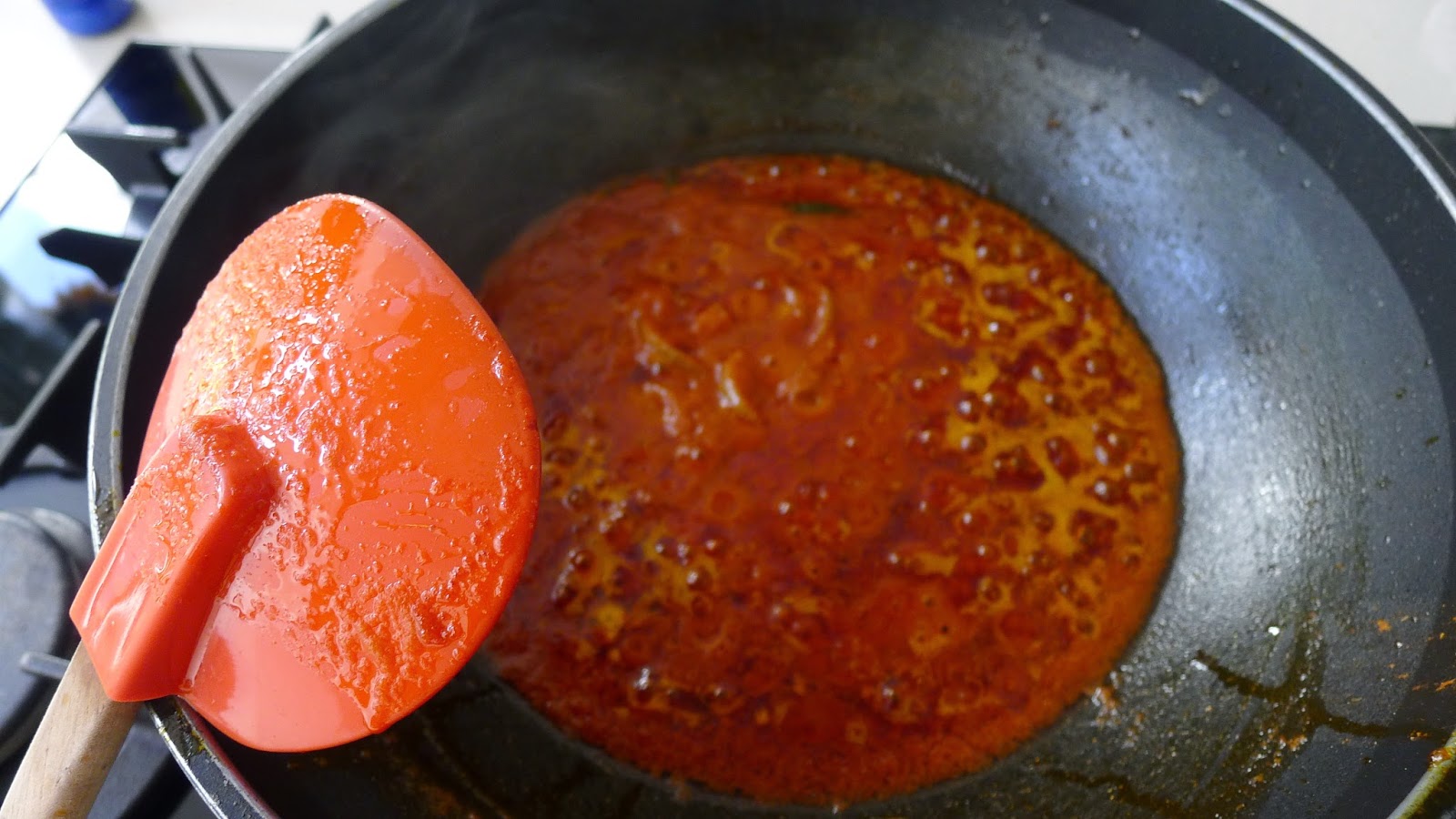

Then add the Mackerel to the sauce and cook for a further 3 minutes. 


In a separate bowl add 200ml of water to the Egusi (Melon Seeds) and mix till you have a double cream consistency. 


At this stage reduce the temperate to a low heat and add the Egusi sauce. 


Cover this  and allow the sauce to steam the Egusi for about 5 minutes. 
Take care in stirring the sauce as you don't want to break the Mackerel into tiny pieces. 


On a high heat boil the Cocoyam leaves for about 8 minutes or if you're using Spinach leaves, just blanch them for 30 seconds.

To blanch spinach;

Bring water to a boil in a saucepan. 
Take the saucepan off the heat and add the washed spinach. 
Mix it thoroughly for 30 seconds (till the spinach wilts).

Drain the spinach into a colander and run it under cold water, (this stops the spinach from cooking further and maintains it's green colour).

Make sure you squeeze any excess water out of the Spinach. 

Using an earthen ware pot or a food processor add the spinach, some chillies from the sauce (if using Kpakpo Shinto) and blend/grind to a smooth paste.


The traditional earthen ware clay mortar with it's wooden pestle.

Add the Spinach to the sauce and mix together evenly, still taking care not to break the Mackerel into pieces. 
Cook for a further 2 minutes and turn off the heat.


Serve with either boiled Yam,Cocoyam, Plantain, Cassava or steamed rice and Avocado. 


Best with homemade pineapple and ginger juice. Enjoy! All photos and recipes are by the owner of this blog. 

Find more inspiring recipes on my YouTube channel, 'Ndudu by Fafa'. Don't forget to subscribe and share.


Tuesday, 15 November 2016

YAM HASH BROWN RECIPE


Hash browns are firm favourites of most people, especially when served as an accompaniment to a full English breakfast. 
The idea of incorporating Yam into this recipe was to reinvent this classic dish with my 'Ndudu Twist'. Yam is to an African what Potatoes is to most. Yam can be boiled, roasted , baked and fried just as you would use Potatoes. Read more.


 Yam has a sweeter taste, it's starchier and creamier in texture to Potatoes, hence a perfect ingredient to use for a tastier hash brown version.
Naturally most Hash browns are tasteless , however by adding shallots and Jalapeños to this Yam HASH brown, you achieve a slightly sweeter flavour, with a hint of heat , a creamy and crunchy texture.
If you prefer a slightly bitter taste then use the head part of the Yam. The best part of the Yam (my preference) is the middle part, as It's sweeter and creamier when cooked. The head part of the Yam when cooked is denser and slightly bitter, whilst the tail part is equally bitter but has a slight shredded water filled texture  when boiled. 


Yam is also rich in Pottasium, Vitamin B6 and Vitamin C. A 100g serving  is about 118 calories and it's best served with a protein based sauce,stew or soup for a healthier dish. 
In Ghana 🇬🇭, Yam is consumed with a Spinach and Mackerel based sauce, A smoky Aubergine sauce, it's also pounded into a pliable texture which accompanies soups such as ; 'Goat and Tomato soup', 'Chicken & Peanut soup' (Nkatie Kwan), Palm nut soup with Tuna, to mention but a few. 
West Africans high consumption of Yam (particularly Nigerians 🇳🇬 and Ghanaians 🇬🇭) in the diaspora, has enabled Yam to be readily available in most Supermarkets and local grocers. When next you're shopping for your groceries, replace Potatoes with Yam and thank me later.

Watch how to make this below, on my YouTube channel, ‘Ndudu by Fafa’.


I love reading and hearing your feedback about my recipes, hence don't hesitate to leave comments below and share the recipe.

 
Shredded Yam

Ingredients 
400g of shredded Yam (Use a grater).
2 finely diced Banana shallots 
Half finely diced Jalapeño pepper
1 large whisked egg
10g of Goats butter or your preferred butter
2 tablespoonfuls of Olive oil or Coconut oil
Salt to taste


Method 
Peel the Yam and using a grater shred into thin pieces / julienned 
Wash the shredded Yam under lukewarm water for 3 minutes and cold water for 30 seconds (to get rid of the starch).
Transfer the shredded Yam into a tea towel and squeeze out any excess water.


Transfer the shredded Yam into a bowl. Add the finely diced shallots, Jalapeño chillies, egg and salt to taste. Mix everything together and set aside.


Place a frying pan on a low heat and add your preferred oil. Warm the oil up gently for 3 minutes and add your butter. Once your butter has melted add the Yam mixture and spread evenly.
 Keep stirring for 5 minutes as it gently cooks.
Using your spatula gather everything into a neat circle (as shown above).


Fry gently for 5 minutes on each side till each base forms a perfect crust, as shown above.

 
Toppings 
You can be creative with your toppings and a perfect opportunity to use up leftover stew, sauce, Vegetables, Meat or fish. 


Don’t forget to subscribe, like the video, try the recipe and share with family and friends.

All photos, videos and recipes are by the owner of this blog.

Thursday, 25 December 2014

Handcut Yam Chips and Mackerel Mousse.


Ingredients 

500g of Yam peeled and cut length ways into segments
Pinch of salt
1 litre Vegetable oil

Mackerel mousse

500g of smoked Mackerel 
1 teaspoon of grated ginger
1 tablespoon of extra virgin oil
1 teaspoon of freshly ground black peppercorn
Finely diced 30g of spring onions or sweet onions 
2 tablespoon of Yoghurt
1 teaspoon of lime / lemon juice
1 teaspoon of Horseradish 
2 de-seeded green chillies, finely diced
Pinch of salt to taste. 

Method;

Pour the oil into a saucepan and place on a medium heat 

Wash your hand cut Yams and discard the water

Sprinkle a pinch of salt on the Yam and mix

Test the oil is hot by adding a slice of Garlic (or anything that can fry and add flavour to the oil). If the garlic sizzles you know you have a hot oil . (Please treat hot oil with utmost care, preferably handle with a glove) 


Add the hand cut Yams to the oil and fry for about 4 minutes. 

After 4 minutes lower the heat under the Yam and add 160ml of water. ( please do this gently and with care) Once the water hits the oil there will be loads of bubbles caused by the reaction of water and hot oil. When the initial bubble has settled down to manageable reaction increase the heat to it's initial 'medium heat'.

Adding water to the Yam, gives the Chip a soft, moist and crumbly inner part with a crunchy exterior. 


Watch as the water disappears from the oil, the chips forming a crispy exterior when touched with a slotted spoon ( this should take about 4 minutes).

Once the water has disappeared , the chips will be crunchy, remove from the oil with a slotted spoon to a clean kitchen napkin or paper to blot off excess oil. 


Make the Mackerel Mousse whilst the Yam is cooking

Take the skin, bones and head off the Mackerel ( if using a whole smoked fish with it's head on) or  better still you can use a pre dressed Mackerel (available in most supermarkets in the UK)

In a seperate bowl add the olive oil, horseradish, yoghurt, black pepper and ginger; mix it together to form a dressing. 


You can blitz your Mackerel in a food processor ( I prefer to use the back of a fork to mash the fish into a rough paste in a bowl) 
I like my mousse to have a crunch and a bite. 

Add the mashed Mackerel to your dressing and stir till well mixed and a fluffy. 

Add your onions, lime/lemon juice and chillies. 

Please taste before adding the salt. I recommend just a pinch as the lime juice and natural yoghurt add a salty taste to the mouse. 

Spoon a portion of mousse into a bowl / plate garnish with strips of red peppers (optional) , drizzle with a little olive oil and serve immediately with your hot 'Handcut Yam chips'. 


Enjoy

All photos are by the author of this blog. 

Saturday, 13 December 2014

Harmattan Christmas with Pawpaw

December in Ghana, with the dry season in tow, family from across the diaspora visiting home to celebrate Christmas, the pop up bars, eateries and shops to accommodate the throng of people, the general excitement of the children, the work overload of Tailors and Seamstresses to finish their handiwork, the well fed Chicken running to pick at the maize thrown it's way (oblivious to the fate that awaits it on Christmas day) is a unique experience.          


Christmas as a child in Ghana meant something new, loads of fuss from visiting Uncles and Aunties, who secretly hand you some money for a treat or two, new clothing, shoes and as a girl a new hairstyle (where the natural hair is chemically straightened, a hot comb passed through the hair or braided and held tightly, (where the foreheads are on full display). 

Painting by Kofi Agorsor, one of the finest artist in Ghana


The best part of Christmas for children is the game 'Try your luck'. The game is a board full of different sizes of balloons , you pay, guess a number and hope it's for a bigger balloon. This ignites a competitive streak in the kids as they always wish to win the bigger balloons. 

My memory of visiting 'Makola' (central market) in the centre of 'Accra' (capital of Ghana) during December was that of a busy scene with people bargaining, negotiating , sweating, the 'mate' (bus conductor) for the 'Trotro' (local public bus) screaming 'Circle, Circle' and passengers hurriedly joining the bus, as it's stopped right in the middle of traffic, the vast amount of different Christmas decorations that glitter as they catch the sun, occasional stench from the open gutters added to heightened sense of excitement in the air. 


A walk through the market on a rather hot afternoon with the market ladies shouting 'Awula (lady) have a look at my wares', the architectural assembly of tomatoes, (I'm always tempted to shake them) the wide beamed hats of the ladies (shading themselves from the hot weather), the beads of sweat running down their faces and the display of fresh produce for the buying public is intoxicating. The sight of the Coconut seller pushing his track and stopping as several people call for his attention 'Kube Wra' and a glance of the 'Asaana' seller serving a quench busting portion of her drink in Calabash with ice cubes, gives one a difficult choice to make. 


On Christmas morning (almost 80% of Ghanaians are christians) you'll find  both men and women in the most colourful outfit made out of African prints or Kente ( a handwoven Ghanaian cloth) all heading to church. 
Church on Christmas day is one filled with excitement, a charged atmosphere of hymns and everyone wishing each other a merry Christmas. 


The other trend in Ghana was the 'Xmas Box' which most businesses had and one was encouraged to leave money in the box as a form of a Christmas token. 


After lunch most families head off home to enjoy their special meal, which could be Fried Chicken with Jollof rice, Ghanaian rich Salad, Fufu (made out of Plantain and Cassava) light soup, peanut butter soup or Palm nut soup (usually cooked with Chicken, Goat meat, Beef or fish)

In the evening most familes and friends visit each other and they are plied with more food. An authentic Christmas in Ghana always has Picadilly biscuits and Danish cookies involved. 


Christmas presents wasn't a requirement in Ghana, (however i stand corrected if things have changed) one was encouraged to exchange food and donate to the needy. 

Remember the essence of Christmas, help a needy family, be grateful and don't forget to laugh. Merry Christmas! 

Thanks to Ohema Adjoa for the Picadilly biscuit picture. All other pictures are from the author of this blog.