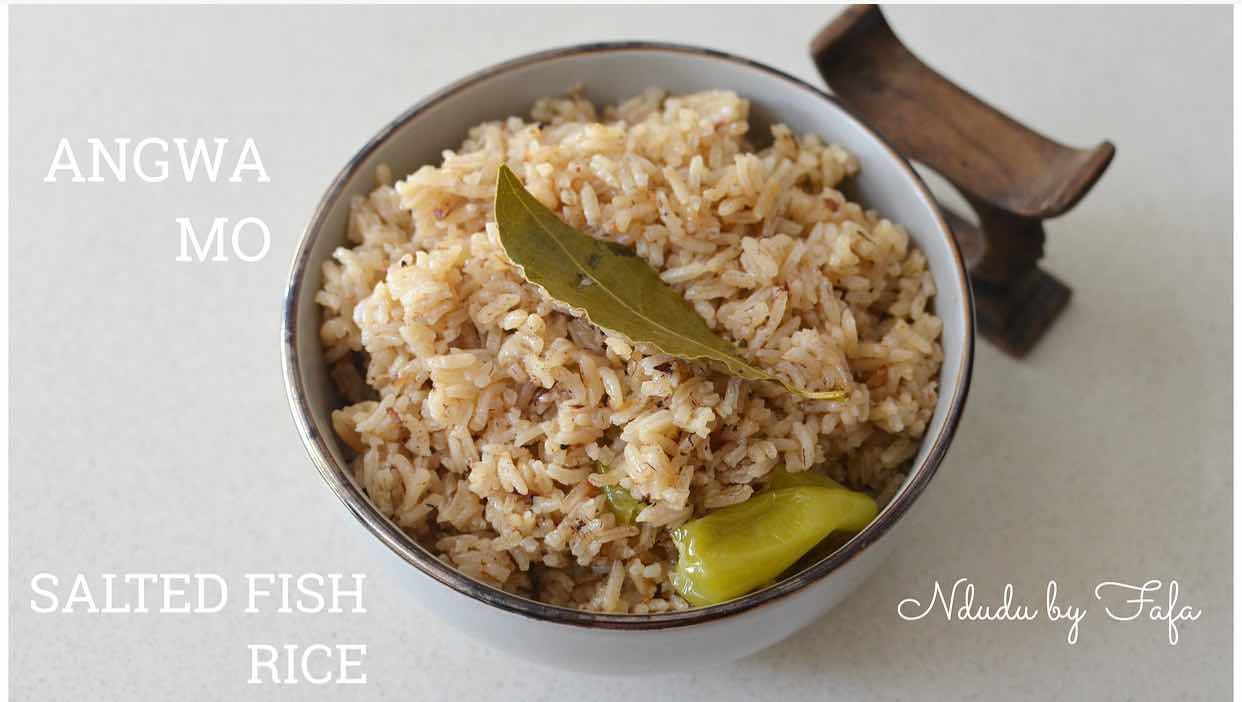
Imagine slow cooked Onion marmalade infused with Koobi(the Ghanaian salted Fish)which is then turned into this beauty called ‘Koobi Angwa Mo’
It’s not like any other Angwa Mo you have ever tasted ooh! This is precision with Fork and Knife separating Koobi ‘tings’ ooh!
You can use any salted Fish you have available including Salted Anchovies for this recipe.
Traditionally the oiled spiced Ghanaian Rice known as ‘Angwa Mo’ is served with an Omelette, Sardines and a hot red chilli sauce. You’ll find elements of these flavours in this recipe.
I can boldly say this ‘Koobi Angwa Mo’ gives Jollof rice a run for its money.
HOW TO COOK THE PERFECT RICE
INGREDIENTS
200g of Jasmine Rice washed till the water runs clear and soaked for 15 minutes
2 large thinly sliced Onions
2 Habanero chillies
4 tablespoonfuls of Coconut oil
100g of Salted Fish cooked in 400ml of Water
150ml of the Salted Fish stock
100ml of Water
Quarter of a teaspoon of grated Nutmeg
2 Bayleaves
Optional Salt to taste
METHOD
Watch how to prepare this amazing (Salted Fish Rice dish (Koobi Angwa Mo) below;
Don’t forget to subscribe, try the recipe, leave comments with your feedback and share.
RECIPE RECOMMENDATIONS
All photos, recipes and videos are by the owner of this blog.
Enjoy this decadent and flavour packed recipe with a nutty twist by Chef Fafa of 'Ndudu by Fafa' .
Serves 6
Preparation time: 10 minutes
Cooking time: 1 hr 30 minutes
Marinating : 3-24 hrs
Mutton
Ingredients
1.5kg of Mutton washed, cleaned and cut into sizeable chunks
Marinade;
30g of Ginger
1 large Onion cut into chunks
1 teaspoon of Ajwan seeds
1 teaspoon of Coriander seeds
1 teaspoon of Cumin seeds
3 cloves of peeled Garlic
3 green chillies
Method
Place all the ingredients for the marinade in a blender.
Add about 40ml of water and blend to a smooth paste.
Mix the marinade with the Mutton and fridge for a minimum of 3hrs.
Tip:
Preferably marinating the mutton overnight is a better option.
Transfer the marinated Mutton to a sauce pan and steam on a gentle heat for 25 minutes.
Add 800ml of beef stock or water to the Mutton and cook for a further 30 minutes or until tender (still on a medium heat).
Transfer it to a baking tray and reserve the stock for the Jollof rice. Bake the Mutton in a pre heated oven of 180*c for 35 minutes or until browned and set aside.
You should have about 250ml of Mutton stock left.
Preparation time: 20 minutes
Cooking time: 1 hr
Tomato sauce
Ingredients
Add 200g of Tomato purée to 250ml of water. Mix to a smooth paste.
800g of fresh sun ripened Tomato cut into chunks
3 large Red peppers cut into chunks (optional)
20g of roughly chopped peeled Ginger
1 Habanero chilli (optional)
10g of crushed Guinean pepper or Grains of Paradise.
Half a teaspoon of all spice
3 large Red Onions
50ml of Groundnut oil
1 Shrimp stock cube
1 tablespoonful of madras curry powder (readily available in most Asian grocers).
1 teaspoon of wild thyme
Salt and pepper to taste.
Method;
Add the oil to a saucepan and place on a medium heat.
Blend the onions, Grains of Paradise, Ginger and chillies into a paste.
Add the 'Onion blend' to the oil and fry for 6-8 minutes (till the volume reduces in half).
Add the tomato purée and cook till it turns into a paste. This should take about 12-15 minutes.
Blend the tomatoes and pepper till smooth.
Add the tomatoes to the saucepan and stir till well mixed.
Reduce the heat to a low setting and cook for 25 minutes, by which time the sauce has reduced by half.
Add the Madras curry, wild thyme, shrimp stock, Mutton and stir.
Cook for a further 15 minutes and constantly stir. Watch the sauce turn into a dark rich colour.
I prefer not to add salt to the sauce at this stage.
The sauce is at it's best, 24hrs after cooking. This allows all the spices to infuse naturally. Making of this sauce is time consuming, hence I make a large portion to last a few weeks.
Best to make the sauce before Christmas Day (to reduce your cooking time on the the day).
This recipe makes 750g of sauce.
Place the sauce in an airtight container and place it in the fridge till you need it.
The sauce will keep in the fridge for 3 days, however it's best to freeze for no longer than a month.
Tip
Personally I prefer to let my sauce rest for
24hrs to enable the spices to infuse. Trust me, your Jollof will benefit from this natural process of infusion.
Preparation time: 25 minutes
Cooking time: 40 minutes
Jollof rice;
Ingredients
750g of dark rich spicy tomato sauce
450g of aged Basmati rice
Alternatively you can use Jasmin rice or long grain rice.
Half a teaspoon of grated nutmeg or mace (readily available in most supermarkets).
3 bay leaves
2 tablespoons of Coconut oil
250ml of Mutton stock
Salt to taste.
Method
Wash the rice till the water runs clear and soak it for about 15 minutes.
Tip
The washing reduces the starch content of the rice hence achieving a perfect, separated and fluffy rice.
The soaking also cuts the cooking time in half and helps the rice to absorb the flavours of the sauce.
Add 500g of the tomato sauce to a heavy based saucepan or a claypot and place on a medium heat.
Warm the sauce up for 6-7 minutes, stirring occasionally and add the washed rice.
Fry the rice in the sauce for 6-8 minutes (making sure the rice has absorbed the sauce and it's well coated).
Add your preferred stock or the Mutton stock, bay leaves, grated nutmeg, salt and stir. Add half of the baked Mutton to the rice and mix.
Once it starts to boil, lower the heat, cover with scrunched up baking paper, grease proof paper or foil and finally cover with the lid.
The whole point of this is to trap the steam in the saucepan and allow the rice to cook with little water. This will also intensify the flavour of the rice.
Mix the remaining half of the Mutton with the remaining 250g of tomato sauce and set aside for later.
Cook the rice for 20-22 minutes, till fluffy and el dente ( I prefer my rice to have a little bite). This is optional and you can steam it till it's completely soft but not soggy.
Turn the heat off and add the coconut oil to the rice and mix well. Cover the rice and leave it to continue cooking in it's steam for 5 minutes. The coconut oil brings all the flavours together by adding a nutty taste to the dish. Thank me later for the tip.
To serve
Ingredients
2 large sliced Shallots
125g of chopped Coriander
1 teaspoon of Groundnut or Coconut oil
Half a teaspoon of Lime/Lemon juice
Salt and pepper to taste.
Method;
Add the oil to a frying pan and place on a medium heat.
Add the sliced shallots and fry till it starts browning. (5-6 minutes)
Add the coriander and stir for 30 seconds
Add the lime juice, salt and mix well for another 30 seconds and turn the heat off.
Scoop your Jollof into a serving plate
Distribute the meat evenly (as shown below)
Sprinkle the onion and coriander mix over it.
Warm the Mutton and sauce up and transfer to a serving bowl.
Side dishes
Fried cubed Plantain
A chunky Avocado and sweet onion salad
Honey glazed roasted carrots
Ever decadent Ghanaian salad.
Merry Christmas everyone and a big thank you for your continuous support. Enjoy!
Watch the Jollof video on my YouTube page
All the photos and recipe are by the owner of this blog. Subscribe to my YouTube page for more recipes.
Ghanaian Jollof is 'bae' says thee, who's Ghanaian 😜 and makes Jollof with a twist.
Jollof rice', is a popular West African dish which originated from the Wolof tribe of SeneGambia. 'Jollof' is a one pot dish with the rice cooked in a spiced rich tomato sauce, which gives the Jollof rice its distinctive Orange colour. One can't present a pale or blush looking rice and call it Jollof 'that's a big no no'. Jollof should always have its distinctive deep Orange colour.
Over the years, Ghana and Nigeria have dominated in it's consumption , therefore sparking a healthy debate, to who makes it better (that in itself depicts the different methods of cooking Jollof).
In recent times, there hasn't been a moment (on social media) where the controversy of Jollof making is discussed, either in a positive, critical or competitive way.
Jamie Oliver tried creating his own version which had a backlash from purists critiquing his technique and finished product.
I've come across a few videos of Jollof making which has received both positive and negative comments including mine, and in instances uncalled for abuse.
Using my leftover Jollof to make a Sicilian inspired Jollof Arancini, where the Jollof can be stuffed with meat, cheese, vegetables etc , rolled into a ball and deep fried in Panko breadcrumbs, shows the diverse ways of enjoying Jollof.
The whole idea of a recipe is to inspire you to cook and add your own twist. It takes a lot of time, effort and cost for either Bloggers or Vloggers to put up a recipe, hence offering encouraging words or advise in a respectful manner will have its desired purpose of educating.
Cooking is an art and shouldn't be restricted to one school of thought; just as creatively someone promoted the use of carrots in the absence of tomatoes for sauces (during the shortage and inflated price of tomatoes in Nigeria).
The buzz about who makes the best Jollof is in tandem with everyones Mum been the best cook, hence asking whose Mum is the best cook will heed no results.
I purposely stay clear of such inconclusive arguments and rather keep pushing the boundaries to deepen the frowns of the purists 😜.
Last year I participated in the World Jollof Rice Day and uploaded a video on YouTube in commemoration of the day and this year I wanted to do a write up of all things Jollof rice. It's been viewed over 100,000 times and see why?...
I've created different types of Jollof rice recipes including one which I incorporated the Nigerian stew 'Buka'. BUKA JOLLOF RECIPE
I've also used sticky rice to make sticky Jollof rice for my canapés and I vividly remember uploading it on social media and a few people jumped on the bandwagon of an over cooked and wet Jollof.😡 Bless!
Types of Rice
In the years of making Jollof rice, I've used Long grain rice, Short grain rice, Brown rice, Basmati rice, Jasmine rice and Sticky rice. My favourite choice will be Jasmine rice as it lends its perfumery taste to the dish.
When using Jasmine rice, it's best to keep your spices to a minimum to allow the flavour of the rice through. A little Ginger, Chilli, Onion, powdered crayfish, a pinch of Nutmeg and bay leaf always works.
Perfect Coconut rice recipe
Cooking Pots
The best pots to use for Jollof rice are either a heavy bottomed pot or a clay pot.
Traditionally Jollof rice is cooked on hot coal or firewood hence the heavy bottomed pot or clay pot helps reduce the speed to which the bottom burned.
I'm fond of the clay pot as heat is evenly distributed and cooks each grain perfectly. Unlike the heavy bottomed pan, you don't need to stir the Jollof rice as much when using a clay pot. The clay pot also offers a natural smoky infusion to the Jollof.
Spices & Herbs
Most people use curry powder, thyme and bay leaf for their Jollof rice. I love experimenting with spices and herbs, hence I've used smoky Ancho Chillies, Pimenton, Rosemary, Nigella seeds, Sage, Kafir lime, Grains of Selim, to mention but a few.
It's exciting experimenting with spices and herbs in creating different flavours of Jollof.
Cooking Methods
Nigerians prefer to par boil their rice before incorporating it into their sauce, however Ghanaians wash the rice and add to the sauce and slow cook.
In my quest for exploring the best way to cook rice a very good friend of mine , Ayesha taught me how it's made in Pakistan. I noticed the method was a cross between the Ghanaian and Nigerian way of cooking their Jollof rice, which was a welcomed education.
The Perfect Jollof sauce
The key to making the best tasting Jollof is the sauce and cooking technique you use.
Find the Jollof sauce recipe here, which you can make in advance and freeze for up to a month.
Jollof Sauce Recipe
Washing your preferred rice till the water runs clear and soaking it for about 15 minutes before cooking, guarantees you a perfect fluffy rice each time.
Once the Jollof sauce is ready add your rice and dry fry it for 5 minutes or until the rice is well coated.
How much water do I add?
Achieving a fluffy and tasty rice requires little water and trapping the steam to cook the rice. Eg; For 350g of rice , I'll use 150ml of water. Trap the steam of the rice by using grease proof paper or banana leaves and cover with the lid till it's perfectly cooked.